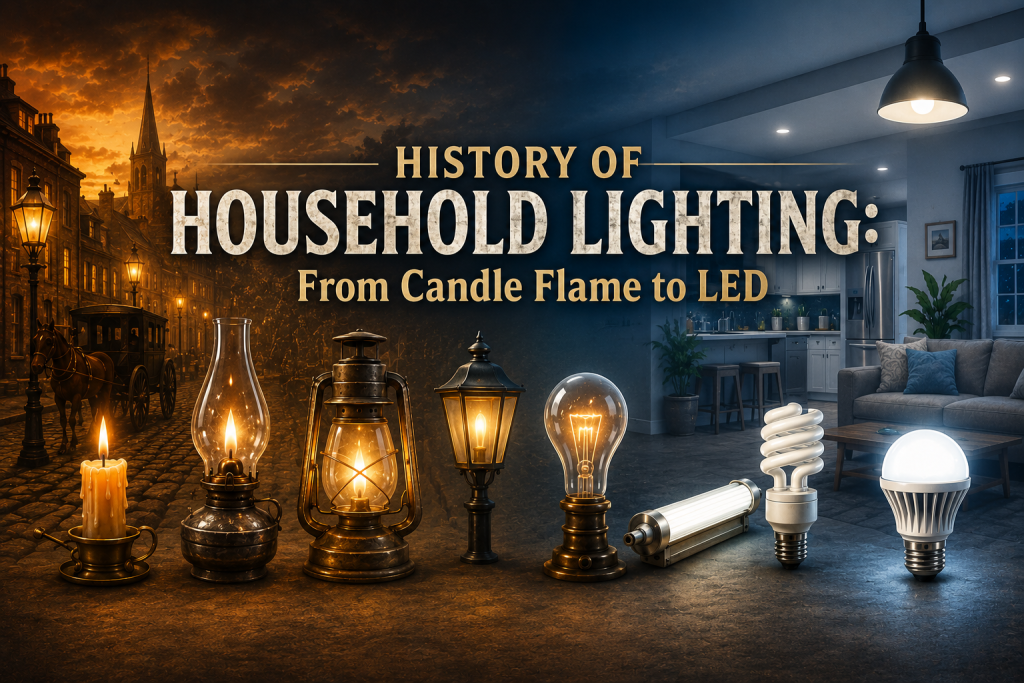

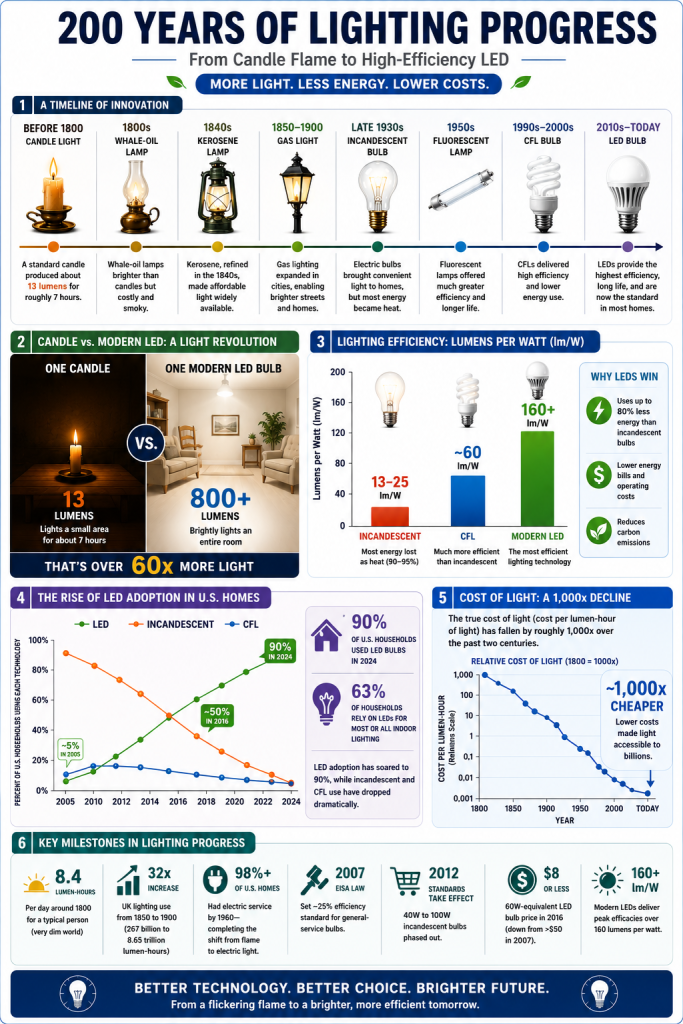
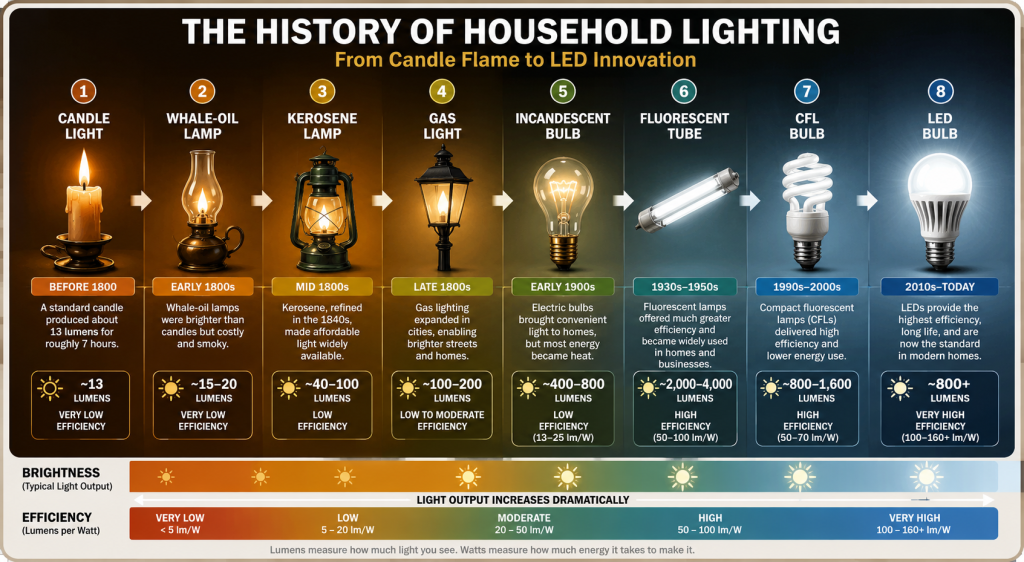
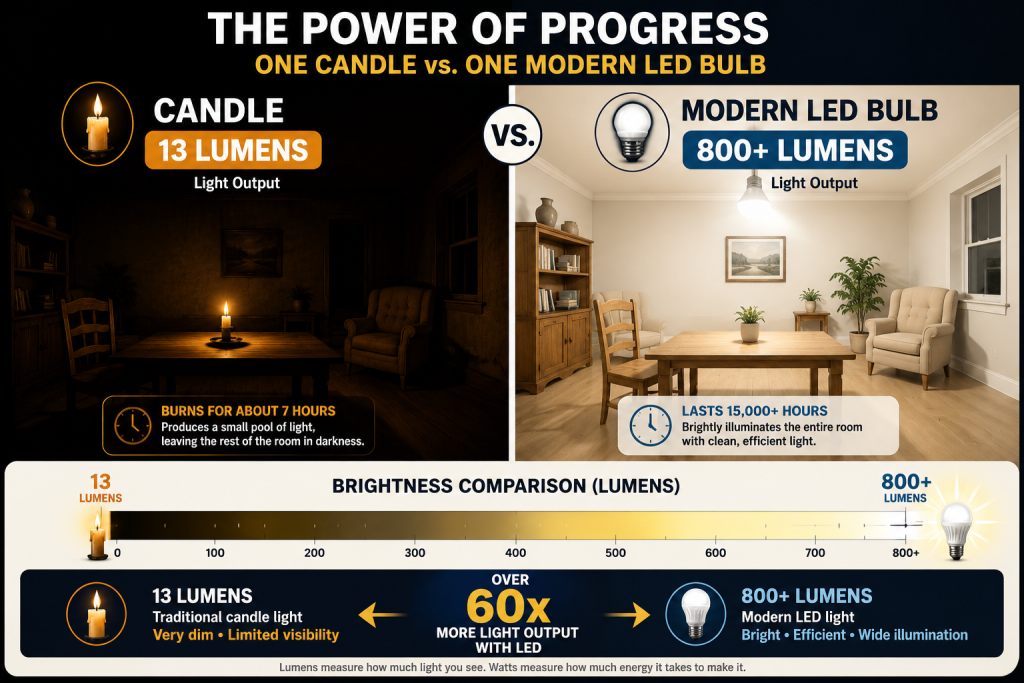
A standard candle once produced just 13 lumens of light for about 7 hours. That was the everyday brightness most people lived by before electricity, with tallow candles giving roughly three-quarters the output of sperm-whale candles. (Nordhaus, NBER, 1996) A single modern LED bulb puts out 800 lumens or more.
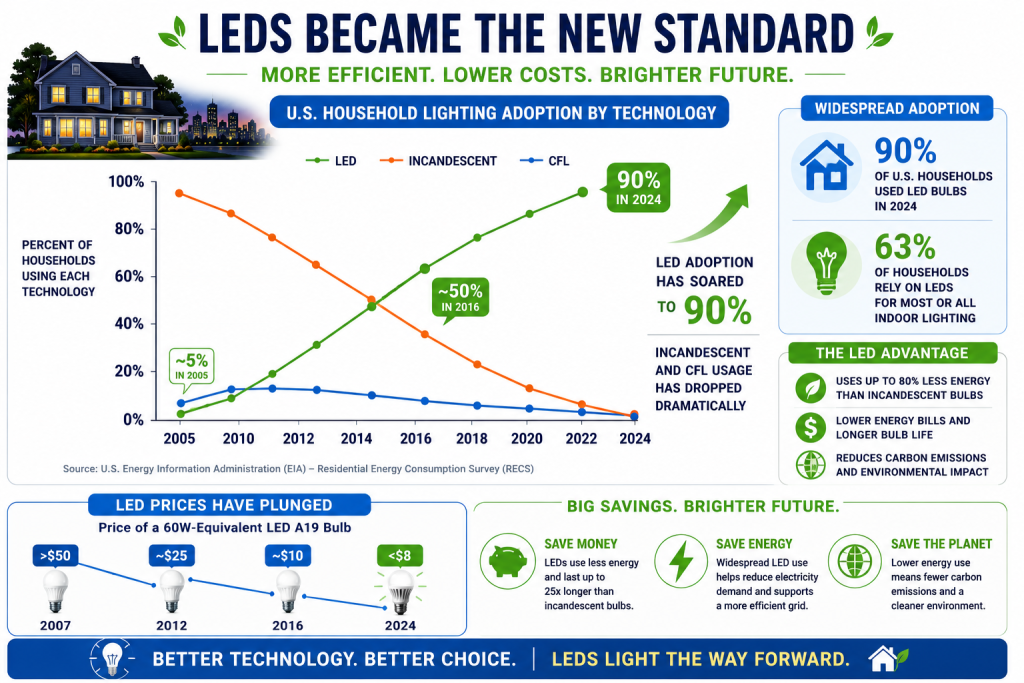
The gap between those two numbers is one of the largest efficiency leaps in human history. By 2015, the average US home held about 52 lighting products, and the country had 8.7 billion lamps installed nationwide. (U.S. DOE, 2017) By 2024, 90% of US households used LED bulbs, and 63% relied on them for most or all of their indoor lighting. (U.S. EIA, 2024 RECS)
This is the story of how we got from one candle to a 90% LED nation.
Quick Skim: History of Household Lighting
| Era | Milestone |
|---|---|
| Around 1800 | A typical person used only about 8.4 lumen-hours of light per day |
| Pre-1880 | Candles, whale oil, and gas dominate; a standard candle gives about 13 lumens |
| 1840s | Abraham Gesner refines kerosene, beginning the shift away from whale oil |
| 1850 to 1900 | UK lighting use jumps 32-fold as gas and kerosene displace candles |
| Late 1930s | Fluorescent lamps first produced in the United States |
| 1950s | Fluorescent reaches general household and commercial use |
| 1960 | More than 98% of US homes have electrical service |
| 2007 | EISA sets the roughly 25% efficiency standard for general-service bulbs |
| 2012 | First EISA wattage standards take effect; 40W to 100W incandescents phase out |
| 2016 | A 60W-equivalent LED bulb falls under $8, down from over $50 in 2007 |
| 2024 | 90% of US homes use LEDs; 63% rely on them for most indoor lighting |
Before Electricity, Light Was Scarce and Dim
Light used to be a luxury. A standard candle weighing one-sixth of a pound produced only about 13 lumens for roughly 7 hours. (Nordhaus, NBER, 1996) Tallow candles, the cheaper option, gave even less.
People rationed it. Around 1800, a typical person consumed an estimated 8.4 lumen-hours of light per day, a little over 3,000 lumen-hours per year. (Fouquet and Pearson, 2006) That is less than a single modern LED bulb produces in one hour.
The long-run economics tell the bigger story. The true price of light, measured as the cost per lumen-hour, fell so dramatically over the next two centuries that conventional price indexes overstate the real cost of light by a factor of roughly 1,000 between 1800 and 1992. (Nordhaus, JEP, 1998) Few technologies in history have gotten cheaper that fast.
The first major break from the candle came from oil. Abraham Gesner refined kerosene in the 1840s, and as whale stocks declined and whale-oil prices climbed, kerosene lamps took over as the affordable household light source. The flame was still a flame. But it was getting cheaper to run.
Demand Explodes as Gas and Kerosene Arrive
Cheaper light created more demand for light. Estimated UK lighting consumption rose from about 267 billion lumen-hours in 1850 to 8.65 trillion lumen-hours by 1900, a roughly 32-fold increase as gas and kerosene displaced candles. (Fouquet and Pearson, 2006)
Here is the part most histories miss. Gas, oil, and early electric light did not spread because they were more efficient than candles. They spread because they were cheaper to run. (Harris, SPACES, 2014) Cost, not efficiency, drove adoption at every stage of this story until the modern era.
One quick note on units, since the rest of this article compares technologies by brightness. One lumen equals roughly 1.4 milliwatts of actual radiant light power. (Harris, SPACES, 2014) Lumens measure how much light you see. Watts measure how much energy it takes to make it. The history of household lighting is the history of getting more lumens out of fewer watts.
The Incandescent and Fluorescent Era
The incandescent bulb electrified the home, but it was wasteful from the start. Incandescent lamps send 90% to 95% of their energy out as infrared heat rather than visible light, with typical efficacies of just 13 to 25 lumens per watt. (U.S. EPA, 2005) Most of the power went to warming the room, not lighting it.
The next step was fluorescent. Fluorescent lamps were first produced in the United States in the late 1930s and came into general household and commercial use by the 1950s. (U.S. EPA, 2005) They were far more efficient than incandescent bulbs and became the standard for kitchens, garages, and workspaces for decades.
But an efficient bulb is useless without power running to it. The real transformation of the American home depended on the electric grid reaching the front door.
Electrifying the American Home, 1900 to 1960
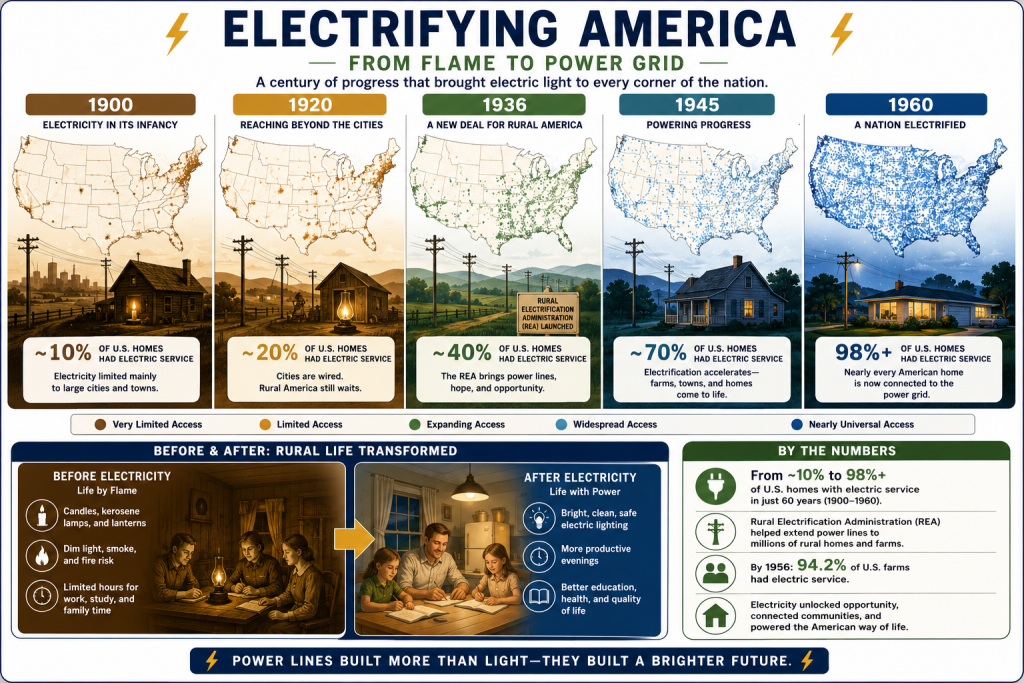
The lit electric home is more recent than most people assume. As late as 1940, half of all US households still relied on coal for primary energy, and another quarter relied on wood. (ACEEE, 2004) Flame-based domestic energy persisted well into the 20th century.
The cities electrified first. By 1960, more than 98% of US homes had electrical service, effectively completing the half-century transition from flame to electric light. (McGill University, c. 2019)
Rural America lagged far behind. Only about 100,000 US farms had central-station electric service in 1920. After the Rural Electrification Administration launched in 1936, the numbers climbed fast. By June 30, 1956, 94.2% of US farms, more than 4.5 million of them, had electric service. (USDA / Census of Agriculture, 1954) A farmhouse in 1930 was far more likely to be lit by a flame than a city apartment was.
The Efficiency Revolution: CFLs and LEDs, 2007 to Today
The modern lighting era starts with a law. The Energy Independence and Security Act of 2007 required general-service light bulbs to be roughly 25% more efficient, with the first wattage standards taking effect January 1, 2012. (U.S. DOE, 2017) That standard phased out the common 40W to 100W incandescent bulbs.
Then prices collapsed. A 60W-equivalent LED A-line bulb cost over $50 when it first appeared in 2007 to 2009, but fell to under $8 by 2016. (U.S. DOE, 2017) The price drop drove mass adoption faster than any mandate could.
The market shifted quickly after that:
- By 2018, LED lamps reached 32.9% of the A-type bulb market, the largest single lighting category, with about 3.5 billion sockets installed. (U.S. DOE, 2020)
- The share of US households using LEDs for most or all indoor lighting rose from just 4% in 2015 to 47% in 2020, while mostly-CFL homes fell from 32% to 12%. (U.S. EIA, 2020 RECS)
- By 2024, 90% of US households used LED bulbs, and 63% used them for most or all indoor lighting. Incandescent and halogen homes fell to 10%, and CFL homes to 7%. (U.S. EIA, 2024 RECS)
Newer homes lead the change. Among homes built between 2020 and 2024, 71% used mostly or all LED indoor lighting, and 51% used LED for every indoor fixture, the highest of any housing vintage. (U.S. EIA, 2024 RECS) If you are building or remodeling, LED is now the default, not the upgrade.
Lumens Per Watt: The Numbers Behind the Shift
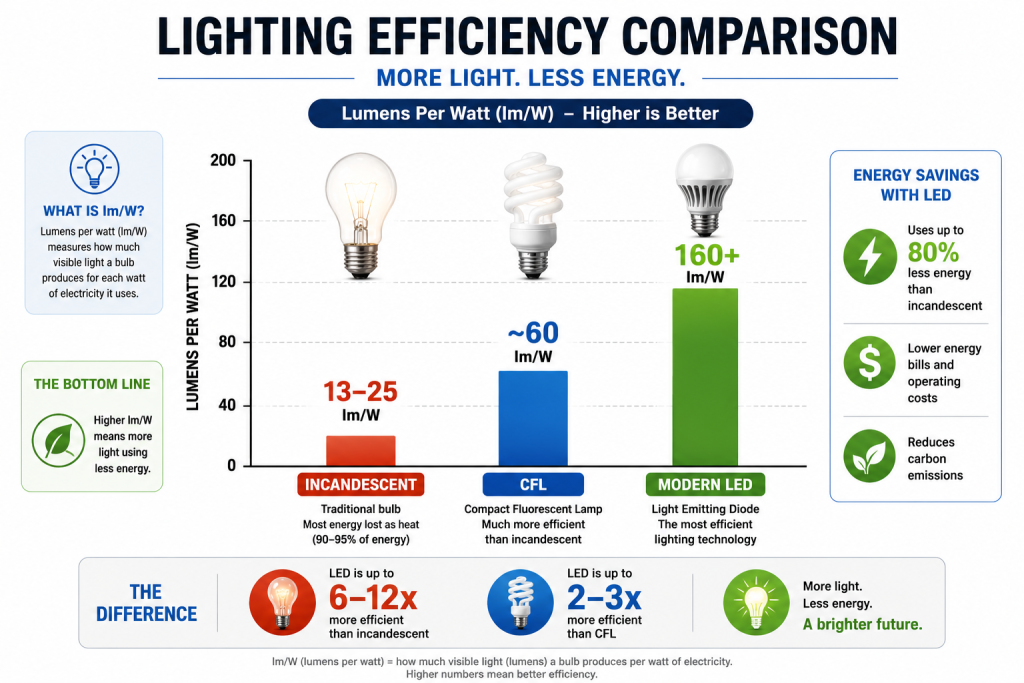
The whole history comes down to one comparison: how much light you get per watt of power. The table below shows why each technology replaced the one before it.
| Light source | Efficacy (lumens per watt) |
|---|---|
| Incandescent | 13 to 25 |
| Pre-transition global residential average | about 21.5 |
| 13W CFL | about 60 |
| Cool-white LED (modern) | over 160 |
Sources: U.S. EPA, 2005; Earth Policy Institute, 2010; U.S. DOE / OSTI, 2014
The jump is dramatic. Cool-white LED package efficacy improved from around 25 lumens per watt to over 160 lm/W, while incandescent bulbs stayed stuck at 13 to 25 lm/W. (U.S. DOE / OSTI, 2014) A modern LED produces six to twelve times the light per watt of the bulb Edison made famous.
Why Lighting Efficiency Still Matters on the Bill
Lighting is a real slice of your power bill. Historically, lighting made up about 18% of US residential electricity use, alongside major appliances at 24% and miscellaneous equipment at 14%. (FSEC / UCF, 2006) When you cut lighting energy by 80% or more by switching to LED, that shows up on the monthly statement.
The stakes are even larger at the national and global level. Lighting accounted for approximately 19% of global electricity consumption, about 2,900 TWh, in the mid-2000s, with projections toward 4,250 TWh by 2030 under existing policies. (IEA SHC Task 50, 2016) Efficient bulbs are one of the cheapest ways to lower both a household bill and a national energy load.
From Candle to LED: A 200-Year Arc
Start around 1800 with a person using about 8.4 lumen-hours of light a day, rationing candles after dark. End in 2024 with a country where 90% of homes run on LED and a single bulb out-lights a year of pre-electric living.
The line connecting those two points runs through kerosene lamps, gas jets, the first incandescent bulbs, the fluorescent tube, the slow march of the electric grid across cities and farms, a 2007 efficiency law, and an LED price collapse that put bright, cheap light in nearly every socket in America.
The lighting you install today is the end product of all of that. When you wire in a modern LED system, you are installing something that took two centuries and a 1,000-fold drop in the price of light to make possible.
Shop LED Lighting at Woodworker Express
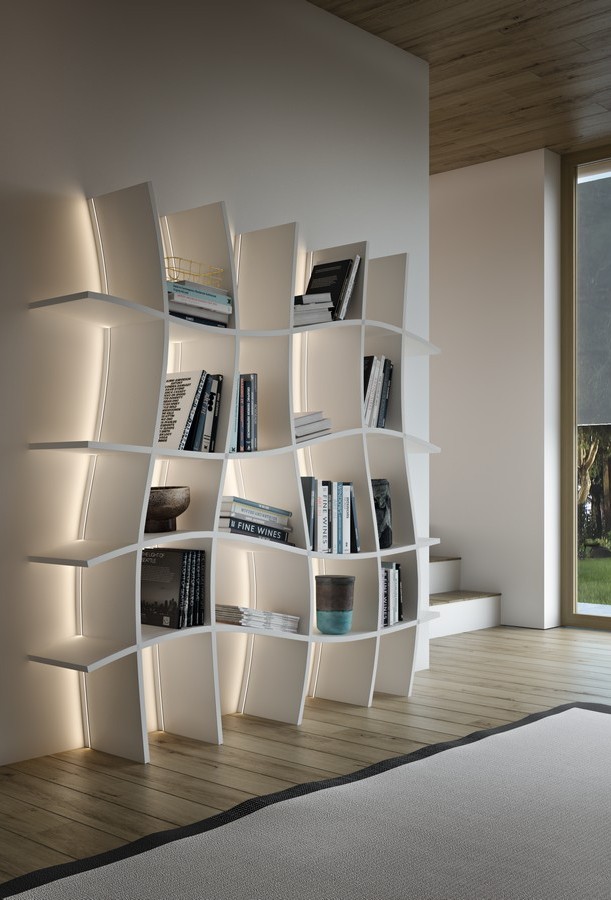
Woodworker Express carries LED strip lighting kits, extrusion systems, and under-cabinet lighting to bring the latest in efficient lighting into your kitchen, shop, or cabinetry project.
Whether you are a homeowner upgrading worn fixtures or a shop building out a full kitchen, we have the LED lighting you need in stock and ready to ship.
Sources
- William D. Nordhaus, “Do Real-Output and Real-Wage Measures Capture Reality? The History of Lighting Suggests Not,” NBER (1996): https://www.nber.org/system/files/chapters/c6064/c6064.pdf
- William D. Nordhaus, “Quality Change in Price Indexes,” Journal of Economic Perspectives (1998): https://pubs.aeaweb.org/doi/pdf/10.1257/jep.12.1.59
- Roger Fouquet and Peter Pearson, “Seven Centuries of Energy Services: The Price and Use of Light in the United Kingdom 1300 to 2000,” The Energy Journal (2006): http://www.csbg.ca/BofD/2006%20Fouquet%20-%207%20Centuries%20Light%20Energy.pdf
- Phil Harris, “Energy Efficiency of Lighting Technologies: An Historical Perspective,” SPACES (2014): https://thespaces.org.uk/wp-content/uploads/2016/05/Phil-Harris_December-2014_An-Historical-Perspective-of-Lighting-Technologies.pdf
- U.S. Environmental Protection Agency, “A Technology Assessment of Light Emitting Diode (LED) Solid-State Lighting” (2005): https://www.epa.gov/sites/default/files/2014-12/documents/technology_assessment_of_light_emitting_diode.pdf
- ACEEE, “Lest We Forget, a Short History of Housing in the United States” (2004): https://www.aceee.org/files/proceedings/2004/data/papers/SS04_Panel1_Paper17.pdf
- McGill University Economics, “The Demographic Effects of Household Electrification in the United States” (c. 2019): https://www.mcgill.ca/economics/files/economics/Demographic.pdf
- USDA / U.S. Census Bureau, “Census of Agriculture 1954: A Graphic Summary, Electric Power on Farms” (1954): https://agcensus.library.cornell.edu/wp-content/uploads/1954-Agriculture_1954_A_Graphic_Summary-MAPS_AND_CHARTS-1089-Table-30.pdf
- U.S. Department of Energy, “Adoption of Light-Emitting Diodes in Common Lighting Applications” (2017): https://www.energy.gov/sites/prod/files/2017/08/f35/led-adoption-jul2017_0.pdf
- U.S. Department of Energy, “Adoption of Light-Emitting Diodes in Common Lighting Applications” (2020): https://www.energy.gov/sites/default/files/2020/09/f78/ssl-led-adoption-aug2020.pdf
- U.S. Energy Information Administration, “Nearly half of U.S. households use LED bulbs for all or most of their indoor lighting,” 2020 RECS (2022): https://www.eia.gov/todayinEnergy/detail.php?id=51858
- U.S. Energy Information Administration, “More U.S. homes used LEDs over other bulb types for indoor lighting in 2024,” 2024 RECS (2026): https://www.eia.gov/todayinEnergy/detail.php?id=67368
- U.S. Department of Energy / OSTI, “LED Lighting Efficacy: Status and Directions” (2014): https://www.osti.gov/servlets/purl/1421610
- International Energy Agency, SHC Task 50, “Building Stock Distribution and Electricity Use for Lighting” (2016): http://task50.iea-shc.org/data/sites/1/publications/Technical_Report_T50_D1_final.pdf
- Florida Solar Energy Center / University of Central Florida, “Appliances, Lighting, Electronics, and Miscellaneous Equipment Electricity Use in the U.S. Residential Sector” (2006): https://publications.energyresearch.ucf.edu/wp-content/uploads/2018/06/FSEC-CR-1675-06.pdf
- U.S. Department of Energy, “2015 U.S. Lighting Market Characterization” (2017): https://www.energy.gov/sites/prod/files/2017/12/f46/lmc2015_nov17.pdf
- Earth Policy Institute, “World Electricity Consumption for Lighting / Energy Efficiency dataset” (2010): https://www.earthpolicy.org/datacenter/pdf/book_wote_energy_efficiency.pdf