

Lazy susans have solved the same basic problem for centuries: too many objects are out of reach.
Today, that might mean a can of soup hidden in the back of a corner cabinet. In 13th-century China, it meant finding one character among tens of thousands of wooden printing blocks.
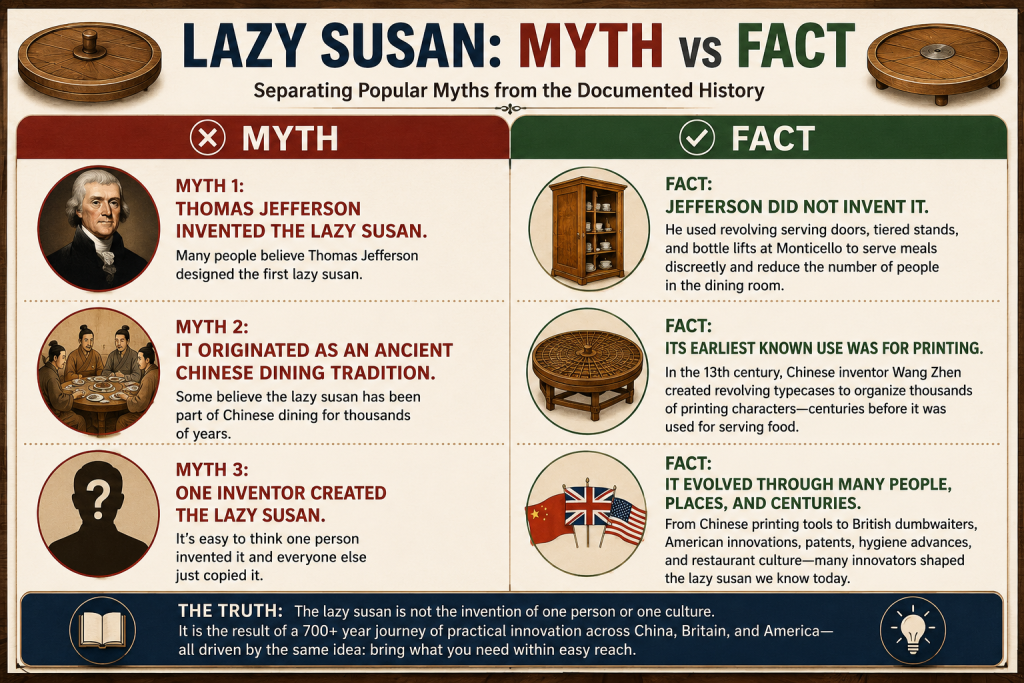
The lazy susan did not begin in an American kitchen. Thomas Jefferson did not invent it. It was not an ancient Chinese dining tradition, either.
Instead, the modern lazy susan emerged through several inventions across different countries and centuries. Printers, furniture makers, physicians, restaurant owners, and cabinet hardware manufacturers all helped shape the rotating storage system we know today.
This is that history.
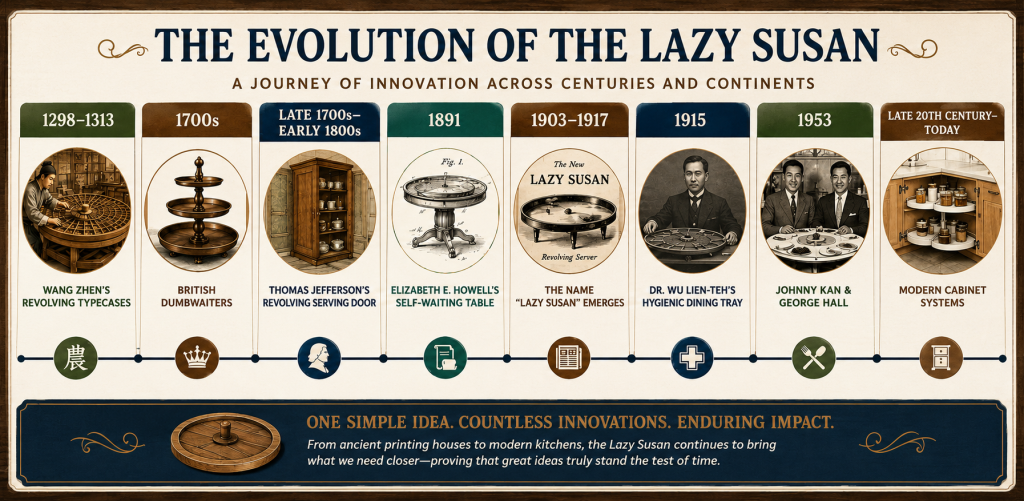
Quick Skim: History of Lazy Susans
| Year or Era | Milestone |
|---|---|
| 1298 | Wang Zhen uses revolving typecases to organize wooden printing characters. [1] |
| 1313 | Wang documents the system in his Nong Shu, or Book of Agriculture. [1] |
| 1732 | A British publication describes servant-replacing furniture called a dumbwaiter. [7] |
| Late 1700s | Revolving mahogany servers appear in British dining rooms. [7] |
| Late 1700s to early 1800s | Thomas Jefferson uses tiered stands, bottle lifts, and revolving serving doors. [2][3][4] |
| 1887 | Mechanical food elevators help redefine the word “dumbwaiter.” |
| 1891 | Elizabeth E. Howell patents a “Self-Waiting Table.” [5] |
| 1903 | The earliest confirmed printed use of “lazy Susan” appears in the Boston Journal. [6][7] |
| 1915 | Dr. Wu Lien-Teh proposes a revolving hygienic dining tray. [8][9] |
| 1917 | Ovington’s advertises a mahogany “Revolving Server or Lazy Susan.” [6][7] |
| 1933 | The term enters Webster’s Dictionary. [6][7] |
| 1953 | George Hall develops a revolving table for Johnny Kan’s restaurant. [8] |
| 1950s to 1960s | Lazy susans spread through Chinese American restaurants and U.S. homes. [8] |
| Late 20th century | Rotating trays become standard corner cabinet organizers. [12] |
| 2026 | Revolving corner trays remain one of the most popular specialty cabinet-storage features. [11] |
1313: The First Known Lazy Susan Was a Printing Tool
The earliest documented ancestor of the lazy susan did not hold plates, spices, or cookware. It held thousands of wooden printing characters.
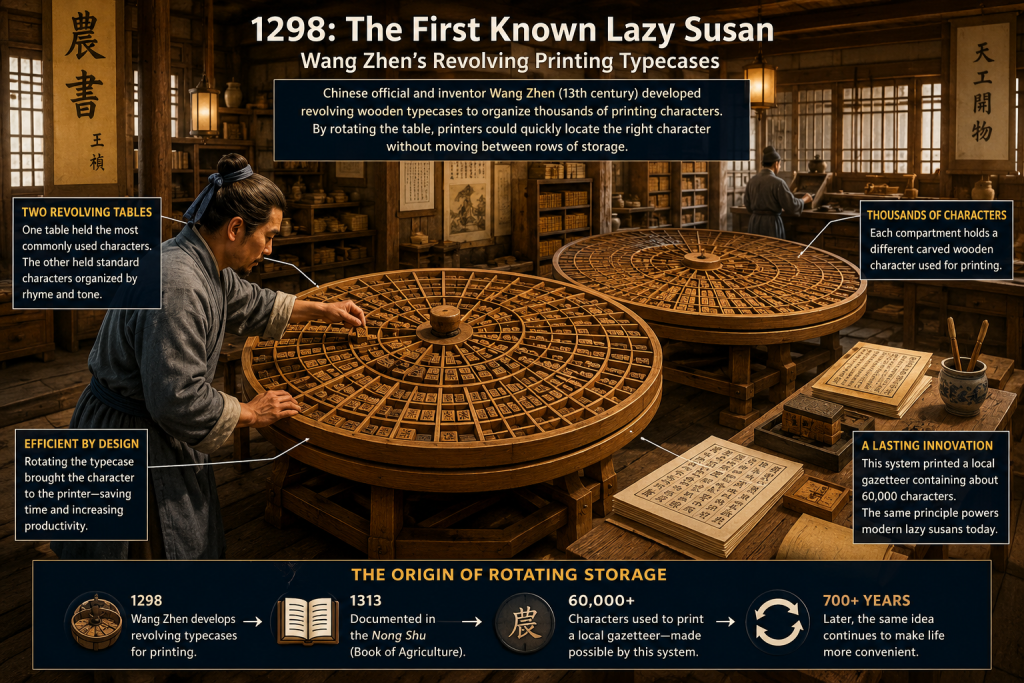
Wang Zhen was a Chinese government official and agricultural writer during the Yuan dynasty. Around the end of the 13th century, he developed an improved wooden movable-type printing system. [1]
The Chinese writing system presented a major organizational challenge. Instead of arranging a small alphabet, printers had to locate thousands of individual characters.
Wang placed the characters on large revolving typecases. A typesetter could turn the table and bring the correct character within reach instead of walking between rows of storage cases. [1]
He used two revolving tables. One held standard characters organized by rhyme and tone. The other held characters used most often. [1]
Wang documented the system in his 1313 agricultural book, the Nong Shu. His wooden type was later used to print a local gazetteer containing about 60,000 characters. [1]
The machine was not a dining-table lazy susan. However, it established the same operating principle.
Rotate the stored objects instead of forcing the user to reach or move around them.
That idea still powers every rotating cabinet tray sold today.
1732: The Dumbwaiter Replaces the Talkative Servant
By the early 1700s, British households were using pieces of furniture designed to reduce the need for servants during meals. [7]
These devices were called dumbwaiters.
The name did not originally refer to a food elevator. It described a silent servant, or an object that could perform part of a servant’s work without speaking, listening, or repeating private conversations. [7]
An April 1732 passage reprinted in The Gentleman’s Magazine complained that human footmen were being replaced by a “Dumb Waiter” that could serve the same purpose without commenting on the lives of its employers. [7]
Early dumbwaiters took several forms:
- Tiered serving stands
- Small tables on casters
- Revolving trays
- Furniture with shelves positioned around a central support
Many were built from fine hardwoods such as mahogany. Some looked more like serving carts than the flat circular trays we recognize today. [7]
The name described the function, not one specific mechanism.
Did Thomas Jefferson Invent the Lazy Susan?
No reliable evidence shows that Thomas Jefferson invented the lazy susan. [2][3]
Jefferson did use several devices called dumbwaiters. That association likely helped create the myth.
While living in Paris, Jefferson became familiar with small tiered serving stands known as étagères. He later used similar stands during small dinners in the United States. [3][4]
He also installed mechanical bottle lifts and a revolving serving door at Monticello. The door had shelves on its reverse side. Workers could load dishes from the hallway, rotate the door, and make the food accessible from the dining room. [2]
Cornelia Jefferson Randolph’s floor plan of Monticello labels the device a “turning buffet.” The revolving door now displayed at Monticello was reconstructed in 1949 using historical plans and an existing example from Bremo, a Virginia estate. [2]
Jefferson used these systems partly to limit the number of people in the dining room. Fewer attendants gave guests more privacy during political and diplomatic conversations. The people completing the work outside the room were often enslaved domestic workers. [3][4]
Jefferson’s devices included:
- Tiered shelves on casters
- Bottle lifts connected to the wine cellar
- A revolving serving door with built-in shelves
None was the familiar tabletop lazy susan. [2][3]
Jefferson helped introduce European self-serving furniture to prominent American homes. He did not invent the rotating serving tray.
How the Dumbwaiter Became a Food Elevator
During the 18th and early 19th centuries, “dumbwaiter” could describe almost any device that reduced the need for a human server. [7]
The meaning changed as mechanical lifts became more common.
By the 1840s, Americans were using the word for small elevators that carried food, dishes, firewood, and other objects between floors.
George W. Cannon patented a mechanical dumbwaiter system in 1887. The success of these lifts helped establish the modern definition of a dumbwaiter as a small service elevator.
Rotating trays still existed. They simply needed a different name.
That new name would not become common until the next century.
1891: Elizabeth Howell Patents the Self-Waiting Table
One of the clearest ancestors of the modern lazy susan came from Maryville, Missouri.
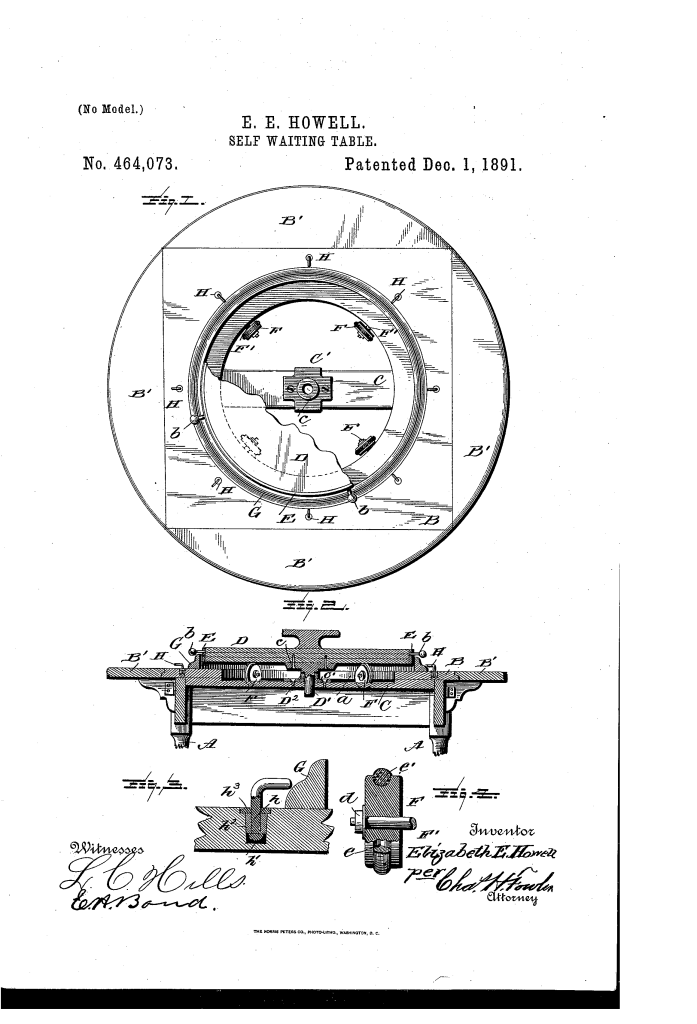
Elizabeth E. Howell filed a patent application for a “Self-Waiting Table” on September 14, 1891. The U.S. Patent Office granted Patent No. 464,073 on December 1 of that year. [5]
Howell did not claim to invent the basic idea of a rotating table. Her patent covered specific improvements that made the table quieter, cleaner, stronger, and easier to use. [5]
Those improvements would sound familiar to any cabinet hardware manufacturer today.
A Quieter Rotating System
Howell placed the revolving tabletop on a central pivot supported by rollers. Each roller had a rubber ring around its edge. [5]
The rubber reduced operational noise. [5]
Modern lazy susan systems use ball bearings, polymer hubs, bushings, and controlled rotation to solve the same problem. A storage tray must turn smoothly without rattling, grinding, or disturbing the items it carries.
Cross-Grain Wood Construction
Howell specified that the revolving section should contain two or more layers of wood with the grain arranged in different directions. [5]
This cross-grain construction improved dimensional stability. It reduced the risk of the circular top warping or splitting as the wood expanded and contracted.
The principle resembles the construction of modern plywood and laminated wood panels.
Protection From Crumbs and Falling Objects
Howell surrounded the rotating platform with a tapered molding. The molding covered the mechanical parts and reduced the opening between the fixed table and the moving top. [5]
It prevented crumbs, dishes, and other objects from falling into the mechanism and blocking its movement. [5]
The design addressed four issues that still define good rotating hardware:
- Smooth movement
- Quiet operation
- Structural stability
- Protection from debris
Howell’s invention was more than a decorative serving table. It was a carefully engineered woodworking system.
The Forgotten Woman Behind the Modern Design
Howell’s name largely disappeared from the product’s history.
Later accounts report that she displayed her Self-Waiting Table at the 1893 World’s Columbian Exposition in Chicago and received recognition for the design. Those claims are less firmly documented than the patent itself, so they should be treated cautiously.
What is certain is that Howell secured a detailed federal patent years before “lazy Susan” became a common commercial term. [5]
Her design included the central pivot, rotating platform, rollers, noise reduction, reinforced wood construction, and protective edge treatment associated with later products. [5]
She did not invent every revolving server. She did produce one of the strongest documented links between 18th-century serving furniture and the modern lazy susan.
Where Did the Name “Lazy Susan” Come From?
No one knows for certain. [6][7]
Theories have connected the name to Thomas Jefferson’s daughter, Thomas Edison’s daughter, Susan B. Anthony, and individual household servants named Susan.
None has convincing documentary support. [6][7]
The most plausible explanation is that “Susan” served as a generic name for a domestic worker. The rotating tray performed part of a waitress’s job, while “lazy” humorously suggested that the device let someone avoid serving the table manually. [7]
The explanation fits the language used in early articles. Those articles repeatedly described the product as an ideal servant, a dumb waitress, or a solution to the shortage and cost of domestic help. [6][7]
But no surviving record identifies one real Susan.
The mystery remains unsolved.
Is the Term “Lazy Susan” Racist or Offensive?
There is no evidence that “lazy Susan” began as a racial slur or referred to a particular racial or ethnic group.
Today, major dictionaries define “lazy Susan” as a standard name for a revolving tray or shelf and do not label the term offensive. [14] For readers who prefer a neutral alternative, “rotating tray,” “turntable,” “revolving shelf,” or “corner cabinet carousel” describes the same basic product.
1903: The Earliest Confirmed Use of “Lazy Susan”
The famous Ovington’s advertisement from 1917 is often credited as the first appearance of the name.
It was not.
Etymologist Barry Popik traced the term to the November 8, 1903, edition of the Boston Journal. The article described Scottish carpenter John B. Laurie as the “resuscitator” of an old device called a lazy Susan. [6][7]
That word matters.
Laurie was not described as the inventor. He was described as someone reviving an existing contrivance. [6]
The article presented his lazy Susan as a revolving mahogany stand that could carry cakes, nuts, sweets, and other small items around a table. It also framed the device as an answer to the “servant problem.” [6][7]
Additional references followed:
- The Idaho Statesman described a lazy Susan as an ideal servant in 1911. [6]
- The Christian Science Monitor discussed a self-serving dinner table in 1912. [6]
- The Lima Daily News reported that the system could remove the need for an extra maid in 1913. [6]
- American Cookery described a German version in 1916. [7]
The term was already circulating years before the advertisement usually credited with introducing it.
1917: The Famous Ovington’s Advertisement
In December 1917, Ovington’s of New York advertised a 16-inch mahogany “Revolving Server or Lazy Susan” in Vanity Fair. [6][7]
The advertisement helped introduce the product to affluent shoppers looking for Christmas gifts. It is one of the earliest clearly documented commercial uses of the name.
But it did not invent the name or the product.
The timing also produced an odd historical contradiction. By January 1918, Century Magazine referred to the lazy Susan as an increasingly uncommon piece of dining furniture, calling it a type of merry-go-round for food. [6]
One publication was promoting it as a clever holiday purchase. Another was already treating it as dated.
The lazy susan had not yet found the application that would make it permanent.
Was the Lazy Susan Named After a Popular Girls’ Name?
Susan became one of America’s most common girls’ names during the 1950s.
It ranked fourth for the decade, with 437,774 recorded births. [10]
That popularity arrived about 50 years after the first confirmed printed use of “lazy Susan.” [6][10]
The timing makes it unlikely that the product received its name because Susan was exceptionally common when the term emerged. The later popularity of the name may have made the phrase sound more natural to mid-century consumers, but it does not explain its origin.
By the time Susan became a household name, the lazy susan was already one.
1915: A Lazy Susan Designed to Fight Disease
The rotating tray also has a surprising connection to public health.
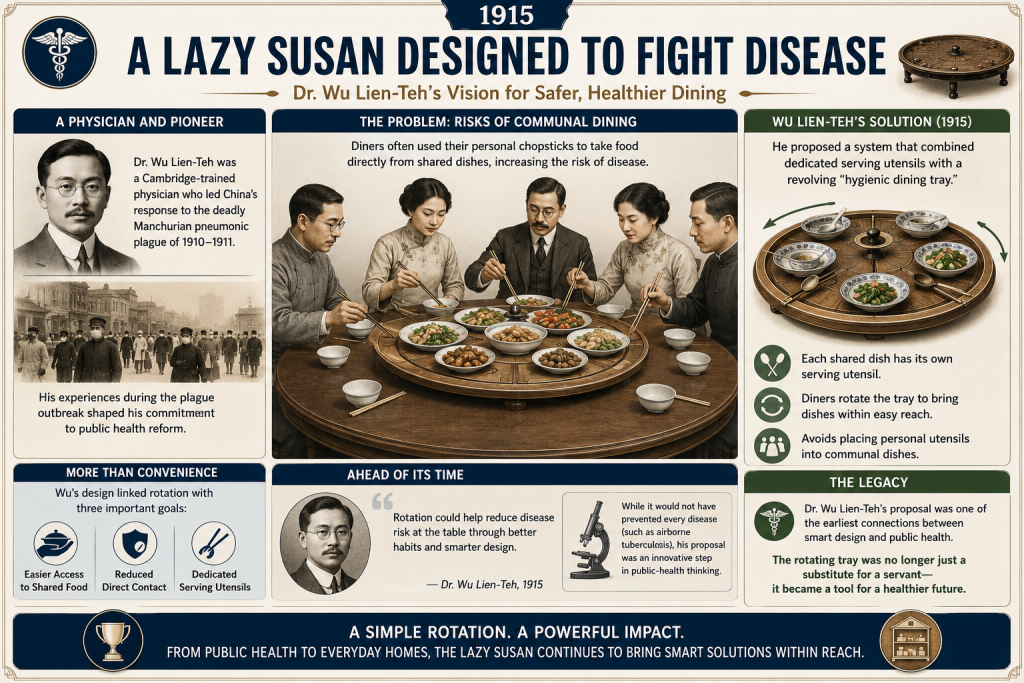
Dr. Wu Lien-Teh was a Cambridge-trained physician who led China’s response to the deadly Manchurian pneumonic plague of 1910 and 1911. [8][9]
Wu became concerned about the health risks of communal dining. Diners often used their personal chopsticks to take food directly from shared dishes. [8][9]
In 1915, he proposed a system that combined dedicated serving utensils with a revolving “hygienic dining tray.” Each shared dish would have its own serving spoon or chopsticks. Diners could rotate the tray, serve themselves, and avoid placing personal utensils into communal bowls. [8][9]
Medical historian Sean Hsiang-lin Lei later examined Wu’s proposal while studying public-health reform in Republican China. [9]
The design would not have prevented every disease Wu associated with shared meals. Tuberculosis, for example, spreads mainly through the air rather than through shared utensils. [8][9]
The mechanism was still nearly identical to a modern tabletop lazy susan.
Wu’s proposal linked rotation with three goals:
- Easier access to shared food
- Reduced direct contact
- Dedicated serving utensils
The device was no longer only a substitute for a servant. It had become a proposed public-health tool.
Was the Lazy Susan Invented in China?
The answer depends on which lazy susan you mean.
China has the earliest documented rotating platform related to the design. Wang Zhen used a revolving typecase in the 13th century. [1]
That does not mean rotating dining tables were an ancient Chinese tradition.
Historical accounts describe Chinese dining tables from earlier periods as stationary and usually rectangular. Wu Lien-Teh presented his hygienic dining tray as a new idea in 1915, not an established custom. [8][9]
Smithsonian’s research concludes that the familiar restaurant lazy susan emerged through cross-cultural exchange rather than one uninterrupted Chinese tradition. [8]
The most accurate answer is:
Rotating platforms have deep roots in China, but the modern dining-table lazy susan developed through several independent inventions in China, Europe, and the United States.
1953: The Chinese American Restaurant Reinvention
The lazy susan found its lasting dining application in San Francisco.
Johnny Kan opened his Cantonese restaurant in Chinatown in 1953. Kan wanted to present Chinese dining as refined, spacious, and modern to American customers. [8]
He worked with George Hall, an engineer and soy sauce manufacturer. [8]
Hall experimented with round pieces of wood and ball bearings. He built a revolving tabletop for the restaurant’s banquet room. The mechanism brought shared dishes within reach while reducing the need for diners and servers to stretch across the table. [8]
Hall’s niece, Chinese American historian Connie Young Yu, remembered the novelty of spinning the table to bring a favorite dish closer. [8]
Hall had traveled in both England and China. His family believed, however, that he developed the restaurant table independently to solve the universal problem of passing food around a large table. [8]
Johnny Kan’s became highly successful. Competing restaurants copied its design, service, atmosphere, and revolving tables. [8]
The lazy susan became a defining feature of Chinese American banquet dining.
The Lazy Susan Goes Global
Revolving restaurant tables spread quickly during the 1950s and 1960s. [8]
A 1963 Washington Post article described one during a Chinese New Year celebration. The New York Times mentioned another at a 1965 Mid-Autumn Festival meal. [8]
The format also moved across the Pacific.
Composer Igor Stravinsky reportedly encountered one at a Chinese restaurant in Japan in 1959. An American visitor found rotating dining tables in common household use in Taiwan by 1971. [8]
Shortly before President Richard Nixon’s 1972 trip to China, the crew of the first American commercial flight to land in Shanghai in decades ate a meal served on one. [8]
Within about 20 years, a restaurant innovation from San Francisco had become associated with Chinese dining around the world.
It appeared traditional because it had become common so quickly.
How the Lazy Susan Entered the American Kitchen
The tabletop lazy susan gained new relevance after World War II.
The domestic service industry had declined. Families needed to perform more household work themselves. At the same time, the postwar baby boom increased demand for convenient kitchens, packaged food storage, and labor-saving products.
Small lazy susans held condiments and serving dishes on dining tables. Countertop versions organized spices, oils, and jars.
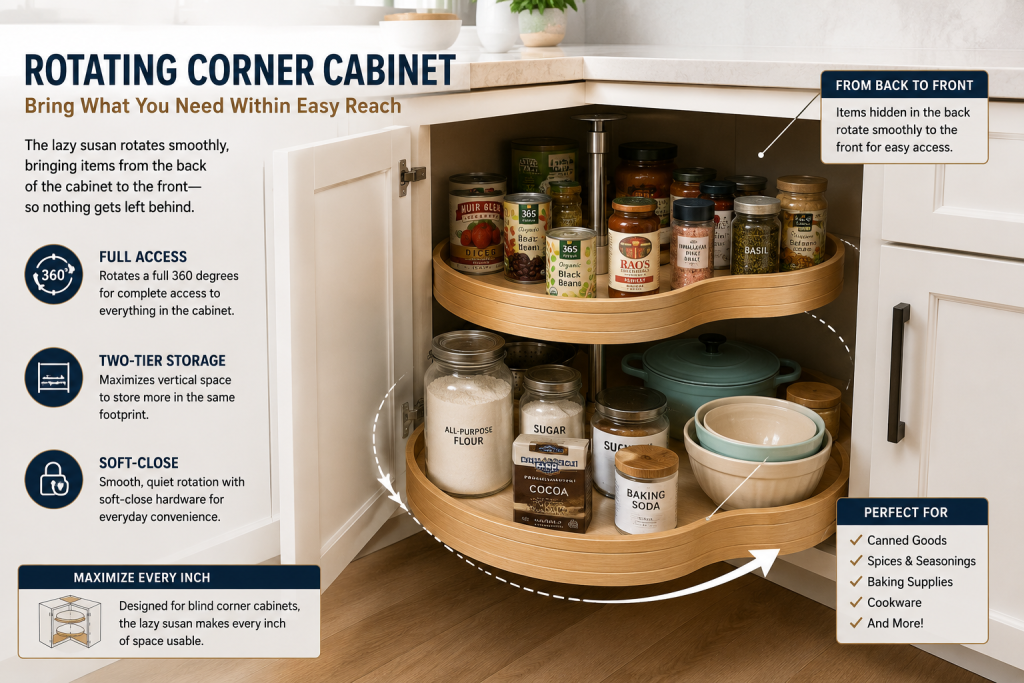
Cabinet manufacturers soon applied the same principle to one of the kitchen’s most persistent design problems: the corner cabinet. [12]
Corner cabinets offer significant interior volume. Much of it is difficult to reach. Items placed deep inside can disappear behind the cabinet opening.
A rotating shelf reverses the problem. Instead of reaching into the cabinet, the user rotates the contents toward the door.
The basic logic had not changed since Wang Zhen’s printing table.
Bring the object to the person.
The Modern Cabinet Lazy Susan
Modern cabinet lazy susans can look very different from their tabletop ancestors.
Some rotate around a center post. Others sit on swivel bearings attached directly to the cabinet floor or shelf. Certain models rotate inside the cabinet, while others pivot and slide through the opening. [12]
Their core parts can include:
- A central post or pivot
- Rotating trays
- Swivel or ball-bearing hardware
- Shelf supports
- Mounting brackets
- Raised rims
- Door-mounting hardware
- Telescoping shafts
The most advanced systems include independent shelf rotation, pull-out movement, soft-close slides, adjustable posts, and heavy-duty load support. [12]
Howell’s 1891 priorities remain visible throughout the category. Manufacturers still work to improve movement, noise, stability, cleanliness, and durability. [5]
The Market Today: Lazy Susans Are Not Outdated
Modern corner storage now includes pull-out shelves, swing-out trays, articulating organizers, and drawer systems.
The traditional lazy susan remains one of the most common solutions.
The 2026 U.S. Houzz Kitchen Trends Study surveyed nearly 1,800 renovating homeowners. It found that 94% of homeowners who upgraded their cabinets added specialty storage features. [11]
Revolving corner trays, pull-out shelves, and deep drawer organizers were each selected by 34% of homeowners looking to improve hard-to-reach spaces. [11]
That puts the lazy susan level with two of the kitchen industry’s most popular modern storage upgrades.
The appeal is simple:
- Rotation provides immediate access.
- The mechanism uses few moving parts.
- Trays are available for several cabinet layouts.
- Wood, polymer, and wire options fit different budgets.
- Replacement bearings and hardware can extend the life of an existing unit.
A lazy susan may be old technology. It is not obsolete technology.
From Wooden Type to Modern Cabinet Storage
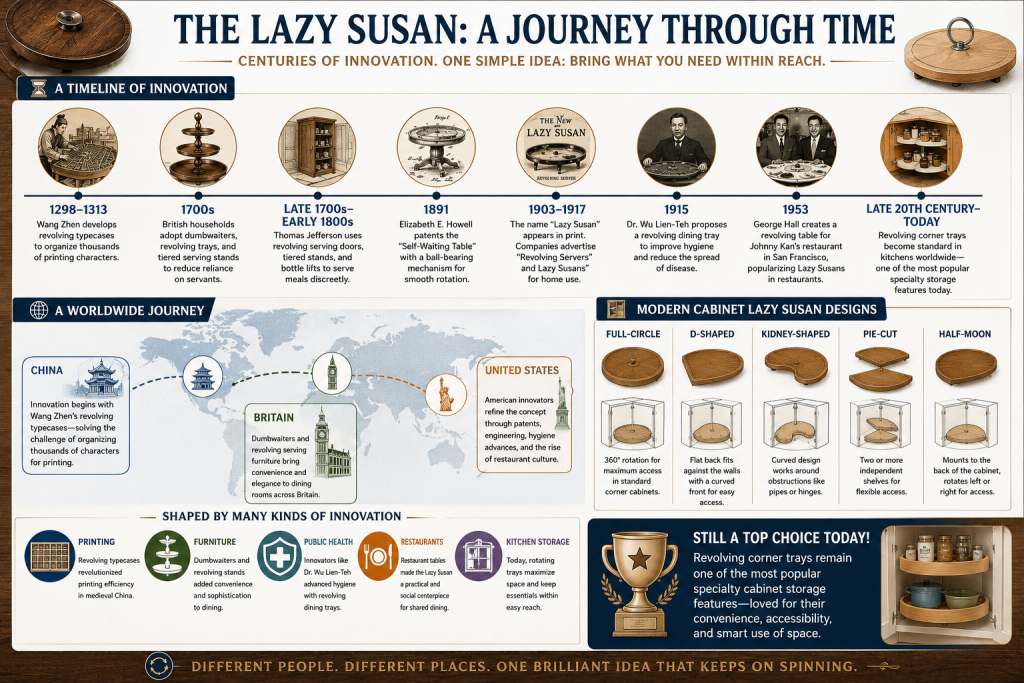
Start with 60,000 wooden printing characters arranged on revolving tables in 13th-century China. [1]
Move forward through British mahogany dumbwaiters, Jefferson’s revolving serving door, Elizabeth Howell’s self-waiting table, Wu Lien-Teh’s hygienic dining tray, and George Hall’s San Francisco banquet table. [2][5][8]
The line connecting them is not one inventor or one country.
It is a problem.
People keep placing objects beyond comfortable reach. Designers keep discovering that rotation can bring those objects back.
The modern corner-cabinet lazy susan is the result of more than 700 years of independent invention, cultural exchange, woodworking, and mechanical improvement.
Every time a cabinet tray turns and brings a hidden item to the front, it uses an idea that once helped a Chinese printer find the right character. [1]
Shop Lazy Susans at Woodworker Express
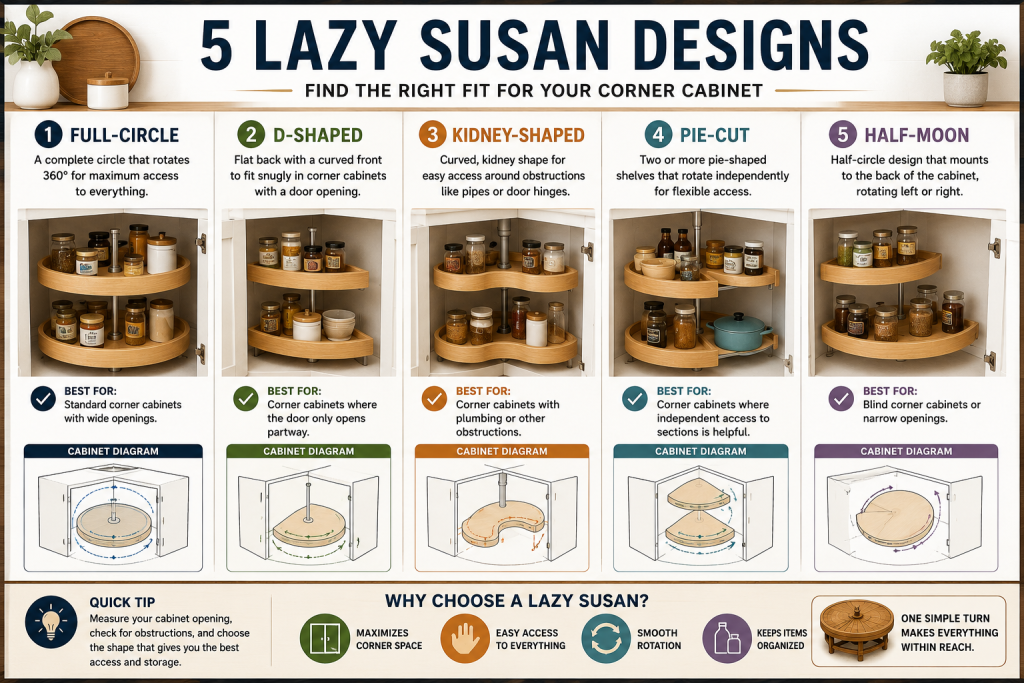
Woodworker Express carries lazy susans for corner base cabinets, wall cabinets, pantry cabinets, and blind corners.
Available configurations include:
- Full-circle lazy susans
- Kidney-shaped lazy susans
- Pie-cut lazy susans
- D-shaped lazy susans
- Half-moon lazy susans
- Lazy susan bearings
- Replacement posts and hardware
Before selecting a system, measure the cabinet’s internal width, depth, height, door opening, and available clearance. Confirm the tray shape, diameter, mounting method, and cabinet application listed by the manufacturer.
Bibliography
[1] Jeremy Norman’s HistoryofInformation.com. “Invention of Wooden Movable Type in China.” Documents Wang Zhen’s wooden movable type and revolving typecases.
https://www.historyofinformation.com/detail.php?entryid=1642
[2] Thomas Jefferson Foundation. Thomas Jefferson Encyclopedia. “Revolving Serving Door.” Documents Monticello’s turning buffet, its operation, and its 1949 reconstruction.
https://www.monticello.org/research-education/thomas-jefferson-encyclopedia/revolving-serving-door/
[3] Thomas Jefferson Foundation. Thomas Jefferson Encyclopedia. “Dumbwaiters.” Documents Jefferson’s use of tiered serving stands.
https://www.monticello.org/encyclopedia/dumbwaiters
[4] White House Historical Association. “Dumbwaiters in Place of Servants.” Documents serving stands used during private dinners.
https://www.whitehousehistory.org/dumbwaiters-in-place-of-servants
[5] United States Patent Office. Elizabeth E. Howell. “Self-Waiting Table.” U.S. Patent No. 464,073. December 1, 1891.
https://patents.google.com/patent/US464073A/en
[6] Barry Popik. “Lazy Susan.” Archival research documenting the 1903 Boston Journal reference and later newspaper appearances.
https://barrypopik.com/blog/lazy_susan
[7] Michael Quinion. World Wide Words. “Lazy Susan: The Mystery Origin of a Kitchen Icon.” Covers early British dumbwaiters and the earliest known use of the name.
https://www.worldwidewords.org/qa-laz1.html
[8] Daniel A. Gross. Smithsonian Magazine. “The Lazy Susan, the Classic Centerpiece of Chinese Restaurants, Is Neither Classic nor Chinese.” February 21, 2014.
https://www.smithsonianmag.com/arts-culture/lazy-susan-classic-centerpiece-chinese-restaurants-neither-classic-nor-chinese-180949844/
[9] Sean Hsiang-lin Lei. “Habituating Individuality: The Framing of Tuberculosis and Its Material Solutions in Republican China.” Bulletin of the History of Medicine. Vol. 84, No. 2. 2010.
https://pubmed.ncbi.nlm.nih.gov/20657056/
[10] U.S. Social Security Administration. “Top Names of the 1950s.” National Social Security card application data.
https://www.ssa.gov/oact/babynames/decades/names1950s.html
[11] Houzz. “2026 U.S. Houzz Kitchen Trends Study.” Survey of nearly 1,800 U.S. renovating homeowners.
https://www.houzz.com/magazine/2026-u-s-houzz-kitchen-trends-study-stsetivw-vs~184213864
[12] Rev-A-Shelf. “Lazy Susans Info.” Manufacturer reference covering lazy susan shapes, materials, hardware, and cabinet applications.
https://rev-a-shelf.com/lazy-susans-info
[13] Harvard Joint Center for Housing Studies. Improving America’s Housing 2025. Documents the size and continued strength of the U.S. remodeling market.
https://www.jchs.harvard.edu/sites/default/files/reports/files/Harvard_JCHS_Improving_Americas_Housing_2025.pdf
[14] Merriam-Webster. “Lazy Susan.” Defines the term as a revolving tray used for serving food, condiments, or relishes.
https://www.merriam-webster.com/dictionary/lazy%20Susan